Bologna: Historic Center Walking Tour
2 hours
A guided loop through the medieval streets of the old town that ends up on Piazza Maggiore itself.
from$76
Check availability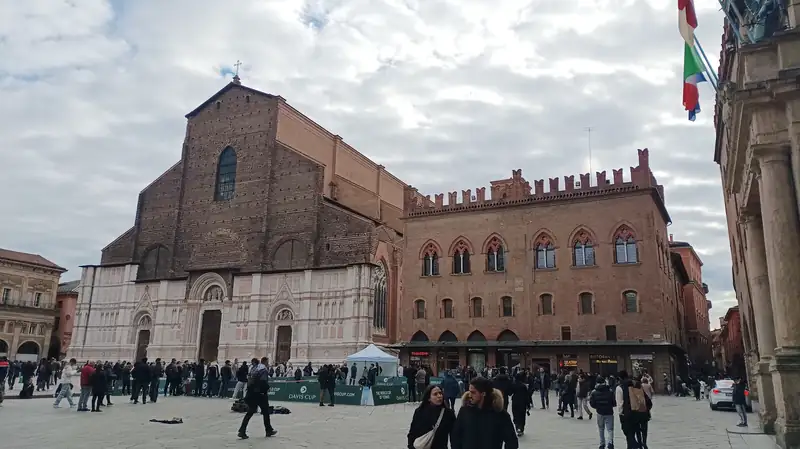
Piazza Maggiore, Bologna
The Basilica di San Petronio fills the south side of Piazza Maggiore. It is Bologna's civic church, begun in 1390 and never finished: the marble facade stops a third of the way up and gives way to bare brick. Entry is free, and a 66.8-meter brass meridian line runs across the floor of the left aisle.
The basilica takes the entire south side of Piazza Maggiore. It runs 132 meters long and 66 meters wide, rises about 47 meters, and holds something like 28,000 people, which puts it among the largest church buildings in the world.
It is not the cathedral. Bologna’s cathedral is San Pietro, a short walk north on Via dell’Indipendenza. San Petronio was a city project, paid for and run by the commune rather than the church, and dedicated to Bologna’s patron saint. That distinction explains a lot about the building, including why the money kept running out.
Construction began on 7 June 1390 to a design by Antonio di Vincenzo. The nave and apse were not finished until 1663, 273 years later.
Stand in front of it and the break is impossible to miss. The lower third is finished marble in pink and white, cut into panels and framed with sculpture. Above that line, bare brick.
Work on the marble started in 1538 and stopped. The version most guides tell is that Pope Pius IV had the Archiginnasio built hard against the basilica’s flank in 1562 to kill Arduino degli Arriguzzi’s plan for a church larger than St Peter’s in Rome. Recent historical work argues that story is a myth, and that the real causes were the ordinary ones: funding dried up and the plans kept changing.
Both versions are worth knowing, because you will hear the papal one repeated in the square all day.
Inside, down the left aisle, a brass line runs 66.8 meters across the floor with a calendar scale beside it. Giovanni Domenico Cassini laid it in 1655, using a pinhole set high in the vault to throw a disc of sunlight onto the pavement. Where the disc lands tells you the date. At the time it was reported to be the longest astronomical instrument of its kind anywhere.
It needs sun. On a gray November morning you will see a brass strip and a lot of tourists walking over it. Around solar noon on a clear day you get the bright oval crossing the line, which is worth timing a visit around.
The side chapels are the reason to slow down rather than walk the nave and leave. The Bolognini Chapel, also called the Chapel of the Magi, has a Gothic marble balustrade of 1400 by Antonio di Vincenzo and a wooden triptych carrying 27 carved figures by Jacopo di Paolo.
That chapel sits on the paid route rather than the free part of the church. Everything else in the nave you can walk around for nothing.
As of September 2026 the basilica opens daily 10:00 to 18:00, last entry 17:50, and entry is free. The museum and bookshop close at 17:30. The Cappella dei Magi route costs €5 full, €3 reduced for ages 11 to 18, over 65s and guided groups, €2 for school groups, and nothing for under 10s, disabled visitors and clergy. Hours and prices change, so check basilicadisanpetronio.org before you go.
This is a working church and the dress code is enforced at the door. Shoulders and knees covered, no tank tops or short skirts, hats off inside, and no luggage or large bags.
The panoramic terrace is closed permanently. Restoration finished and the terrace did not reopen, so any article telling you to climb it is out of date. For a view over the rooftops, look at the Due Torri or the clock tower at Palazzo d’Accursio instead.
2 hours
A guided loop through the medieval streets of the old town that ends up on Piazza Maggiore itself.
from$76
Check availability2 hours
An affordable two-hour orientation walk covering the landmarks of the centre, and the most-reviewed tour in Bologna.
from$33
Check availability1.5 hours
A short small-group walk past the main sights, useful if you only have an afternoon in the city.
from$28
Check availabilityPrices and ratings were taken from GetYourGuide and can change. Booking through these links supports this site at no extra cost to you.
Yes. The main body of the basilica is free, and so is the small museum and bookshop. Only the Cappella dei Magi chapel route charges admission, at €5 full price and €3 reduced as of September 2026.
Work on the marble cladding began in 1538 and was abandoned partway up, leaving bare brick above. A popular legend blames Pope Pius IV for having the Archiginnasio built against the basilica's flank in 1562 to stop it outgrowing St Peter's in Rome. Recent research disputes that and points to money and planning problems instead.
No. The panoramic terrace was closed permanently after restoration work finished and it has not reopened. Older articles still describe the climb, so ignore those. For a high view over Bologna, look at the Asinelli Tower or the clock tower at Palazzo d'Accursio.
It is the meridian line laid by the astronomer Giovanni Domenico Cassini in 1655. A pinhole high in the vault drops a disc of sunlight onto the 66.8-meter strip, and where it lands marks the date on a calendar scale. It only shows anything on a sunny day near noon.
Yes, and it is checked at the entrance. Shoulders and knees have to be covered, tank tops and short skirts are turned away, and hats come off inside. Large bags and luggage are not allowed in.
Half an hour covers the nave, the meridian line and a look into the side chapels from the aisle. Add fifteen minutes if you pay for the Cappella dei Magi route.
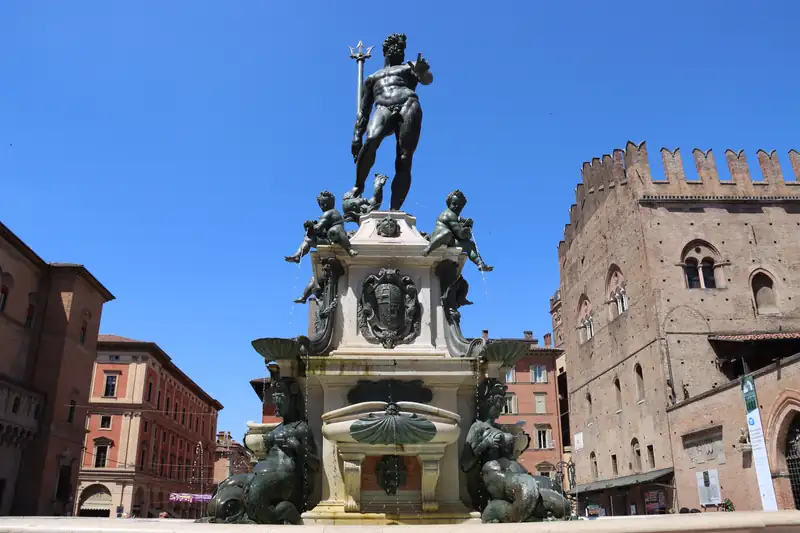
The Fontana del Nettuno stands at the northwest corner of Piazza Maggiore, on the small square named after it.
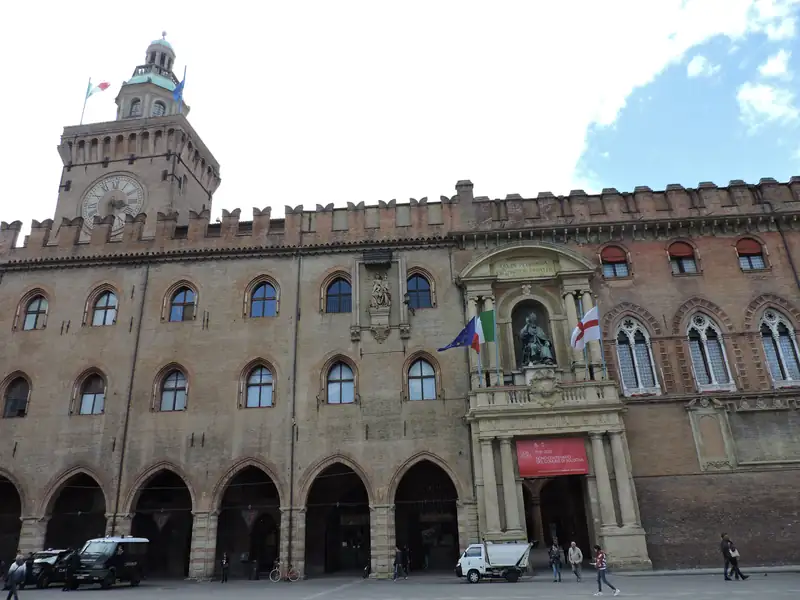
Palazzo d'Accursio is Bologna's town hall, filling the west side of Piazza Maggiore.
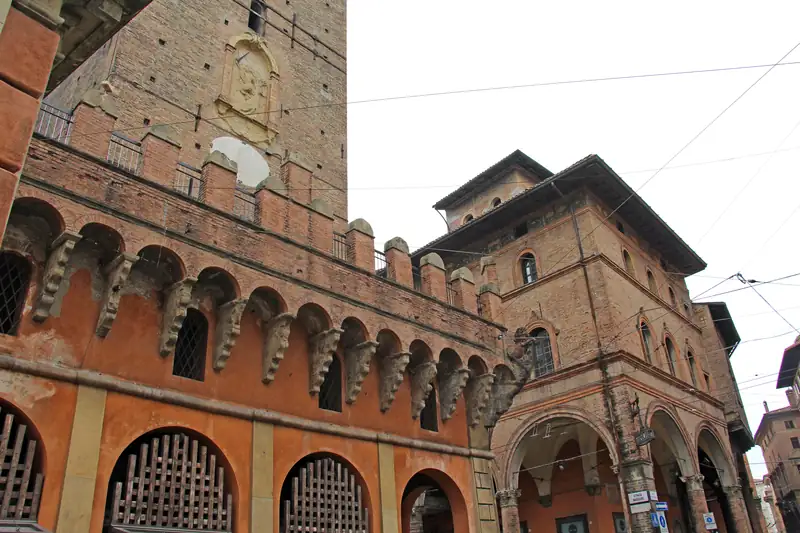
The Due Torri stand at the end of Via Rizzoli, about five minutes east of Piazza Maggiore.
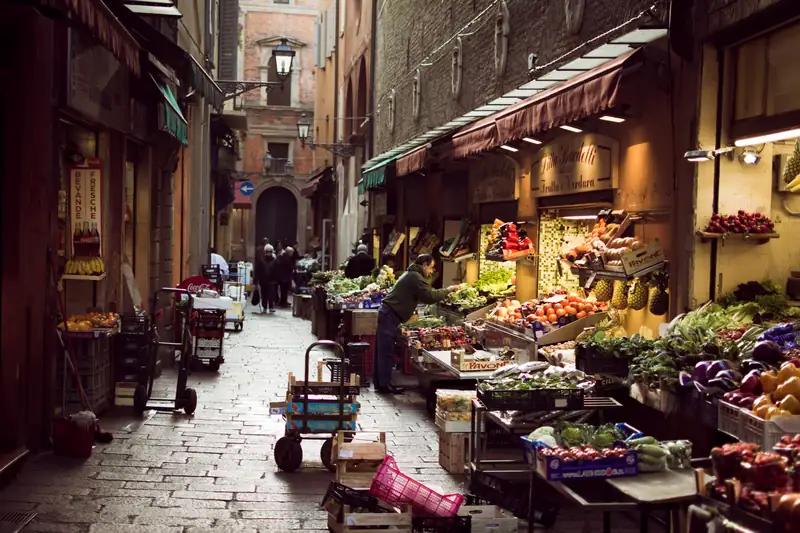
The food is behind the square rather than on it.