Bologna: Historic Center Walking Tour
2 hours
A guided loop through the medieval streets of the old town that ends up on Piazza Maggiore itself.
from$76
Check availability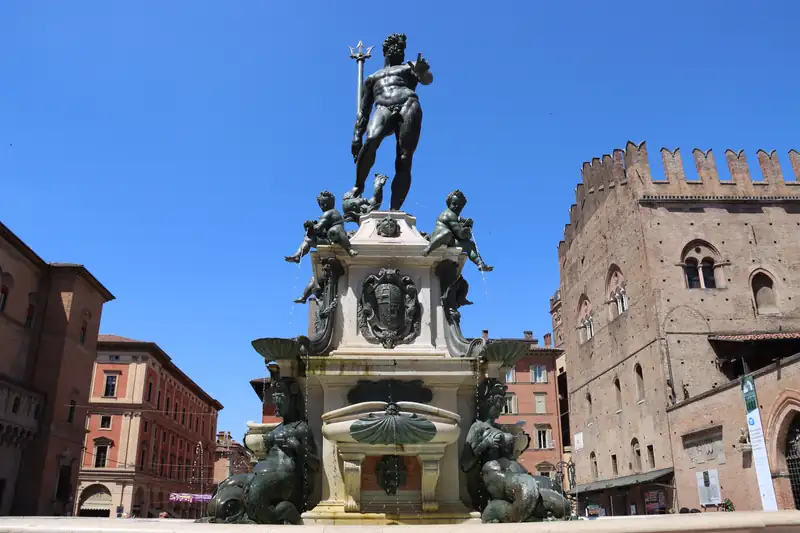
Piazza del Nettuno, Bologna
The Fontana del Nettuno stands at the northwest corner of Piazza Maggiore, on the small square named after it. Giambologna cast the bronze Neptune in the 1560s and Bolognesi call him il Gigante. It is outdoors, free and lit at night, and it hides one famous optical joke.
The fountain sits on Piazza del Nettuno, the smaller square wedged onto the northwest corner of Piazza Maggiore, with Palazzo d’Accursio on one side and Biblioteca Salaborsa on the other. You will walk past it on the way in from the station without meaning to.
Cardinal Pier Donato Cesi, the papal legate governing Bologna, commissioned it in 1563 as a piece of public flattery aimed at Pope Pius IV. Tommaso Laureti handled the architecture and the water engineering. The bronze went to Giambologna, a Flemish sculptor working in Italy, who cast Neptune and the figures around the basin. The work was finished around 1566.
Neptune himself is 3.4 meters of bronze, one arm out, trident down, weight on one leg. Bolognesi call him il Gigante, the Giant.
The politics behind it are worth a second. Bologna was governed from Rome at the time, and a papal legate putting a monumental fountain in the city’s main civic space was making a point about who was in charge. The city got a working water supply out of it and a symbol it has used ever since, which is roughly how these arrangements tend to end up.
Around the basin are four sirens pressing water from their breasts, and putti holding dolphins. That is the actual cast of characters. If you read somewhere that the fountain has turtles on it, we could not confirm that in any source, Italian or English, and we would leave it out.
This is the thing people come for, and almost nobody finds it by accident.
Stand on the dark paving stone set into the ground in front of Biblioteca Salaborsa and look up at Neptune. From that one spot, and only that spot, his outstretched left thumb lines up with his lower abdomen and reads as something anatomical. Locals call the stone the pietra della vergogna, the stone of shame. The trick is attributed to Giambologna, who apparently knew exactly what he was doing.
Look for the stone rather than a plaque. It is darker than the pavement around it and there is usually somebody already standing on it with a phone.
This is an awkward corner for photographs. Palazzo d’Accursio rises behind the fountain on one side and the flat front of Salaborsa closes it on the other, and most people end up shooting into whatever light there is.
Two positions work. From the Piazza Maggiore side you get Neptune with the bulk of the basilica behind him, which is the shot that reads as Bologna. From the far side of Piazza del Nettuno, closer to Via Ugo Bassi, you get him against the tower of Palazzo d’Accursio, which is better in the evening once the floodlights come on.
The one thing to avoid is the middle of a July afternoon, when the sun is directly overhead, the bronze goes flat and the square is at its most crowded.
Students at the University of Bologna hold that walking twice counter-clockwise around the fountain brings luck in exams. The reason given is that Giambologna paced the same circuit while planning the sculpture. There is no way to check this and we are not going to pretend otherwise, but in May and June you will see people doing it.
The fountain went behind scaffolding in 2016 for a full clean and an anti-corrosion conservation project, and came back in December 2017, unveiled just before Christmas. If your mental image of the Neptune is a dark, streaked green figure, that image is from before the work. The bronze reads much lighter now, and the water was reconnected properly at the same time.
2 hours
A guided loop through the medieval streets of the old town that ends up on Piazza Maggiore itself.
from$76
Check availability2 hours
An affordable two-hour orientation walk covering the landmarks of the centre, and the most-reviewed tour in Bologna.
from$33
Check availabilityPrices and ratings were taken from GetYourGuide and can change. Booking through these links supports this site at no extra cost to you.
Cardinal Pier Donato Cesi commissioned it in 1563 to honor Pope Pius IV. Tommaso Laureti designed the architecture and the Flemish sculptor Giambologna made the bronze Neptune and the surrounding figures. It was finished around 1566.
From one dark paving stone in front of Biblioteca Salaborsa, Neptune's outstretched thumb lines up with his lower abdomen and appears to be something else entirely. Bolognesi call that stone the pietra della vergogna, the stone of shame, and the trick is credited to Giambologna.
No. The Fontana del Nettuno sits in the open on Piazza del Nettuno, next to Piazza Maggiore, and there is no ticket or gate. It is floodlit after dark, which is when most people get their best photographs of it.
A University of Bologna tradition holds that walking twice counter-clockwise around the fountain brings luck in exams. The story attached to it is that Giambologna himself paced around the pedestal while working out the design. Treat it as student folklore rather than history.
A full cleaning and anti-corrosion conservation project ran from 2016 and was completed in December 2017, in time for the statue to be unveiled again before Christmas. The bronze has looked considerably better since.
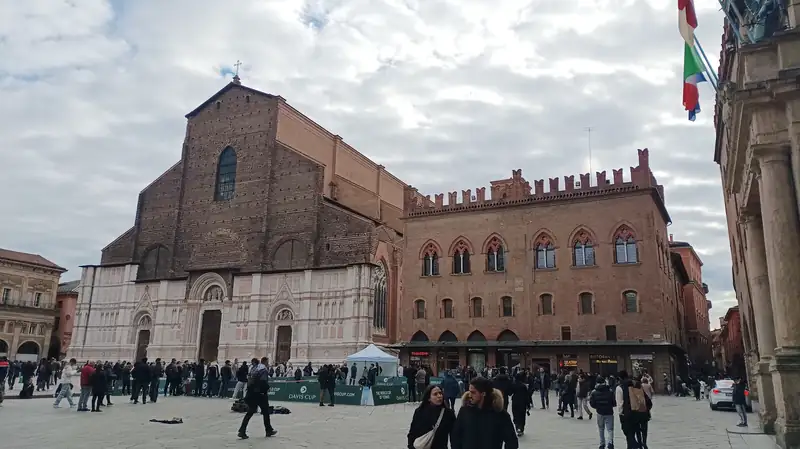
The Basilica di San Petronio fills the south side of Piazza Maggiore.
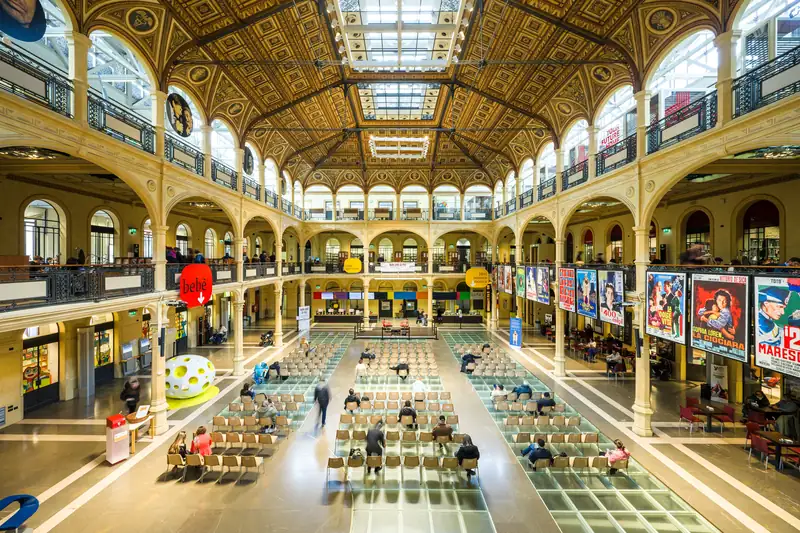
Biblioteca Salaborsa is Bologna's public library, built inside the city's former stock exchange on Piazza del Nettuno.
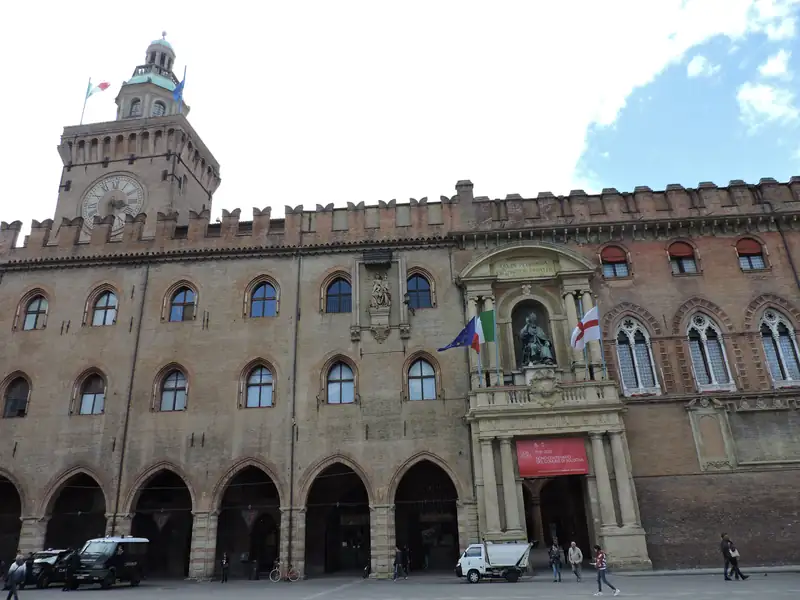
Palazzo d'Accursio is Bologna's town hall, filling the west side of Piazza Maggiore.
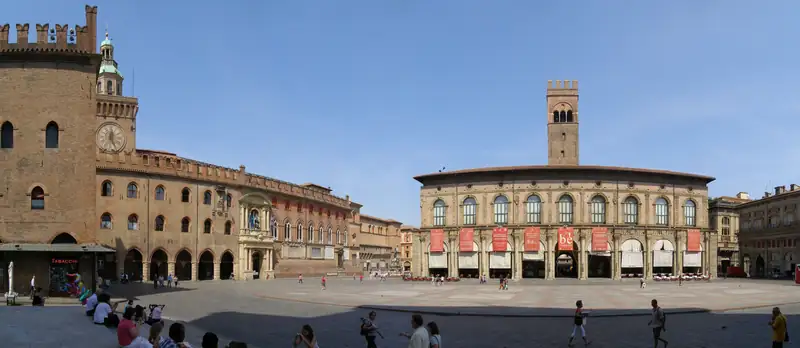
Almost everything worth seeing in Bologna sits within a fifteen-minute walk of Piazza Maggiore.