Bologna Walking Food Tour with a Local Expert
3 hours
The city's best-reviewed food walk, led by a Bolognese guide who explains what you are eating and why it matters here.
from$83
Check availability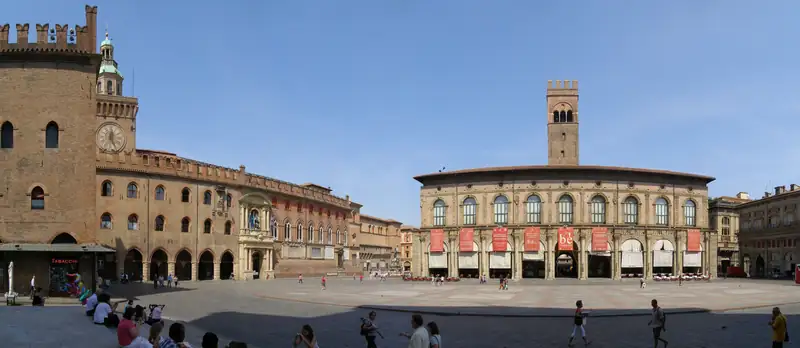
Almost everything worth seeing in Bologna sits within a fifteen-minute walk of Piazza Maggiore. This list starts in the square with the basilica, the fountain, the whispering gallery and the library's glass floor, then works outward to the towers, the market streets, the Anatomical Theatre and the hillside portico to San Luca.
Plenty of people change trains at Bologna Centrale on the way from Florence to Venice and never come into the center. That is their loss and quietly your gain, because the city has one of the best-preserved medieval cores in Italy and a fraction of the queues.
This list starts in Piazza Maggiore and works outward. The first seven items are on or beside the square. After that you are walking, and none of it is far.
The square was cleared from around 1200, when Bologna’s commune bought up the houses and towers standing on the site and demolished them to make a market and a stage for the city government. It measures 115 meters by 60, roughly 6,900 square meters, which puts it among the largest squares in Italy.
The raised granite platform in the middle went in in 1934, about 15 cm above the paving. Bolognesi named it il crescentone after the crescente, the local griddled flatbread it was said to resemble. Sit on the edge of it for ten minutes before you do anything else and watch how the city uses the space.
Basilica di San Petronio takes the whole south side: 132 meters long, built to hold something like 28,000 people, begun on 7 June 1390 and still missing two thirds of its facade. Marble stops a third of the way up and bare brick carries on above it.
Inside, and free, a brass line runs 66.8 meters across the floor of the left aisle. Giovanni Domenico Cassini laid it in 1655 and it works as a calendar: a pinhole high in the vault drops a disc of sunlight onto the strip, marking the date. Go on a sunny day near noon or you will see nothing.
Giambologna’s bronze Neptune, finished around 1566, is 3.4 meters of muscle with a trident, and Bolognesi call him il Gigante.
The reason to look properly is a joke built into the sculpture. Stand on the dark paving stone in front of Biblioteca Salaborsa, known locally as the pietra della vergogna, and from that one spot Neptune’s outstretched thumb lines up with his lower abdomen and reads as something else entirely. Everyone photographs it. Almost nobody finds the stone without being told where it is. Full details on the Fontana del Nettuno page.
Under Palazzo del Podestà, on the square’s north side, a vaulted passage crosses through to Piazza Re Enzo behind. Stand facing one of its four corners, speak quietly into the stone, and a person in the corner diagonally opposite hears you clearly. The curve of the vault carries the sound around the edge.
You need a second person and a quiet moment, so try it early or late rather than at two in the afternoon. Look up while you are there: terracotta statues of Bologna’s four patron saints were set into the vault in 1525.
Biblioteca Salaborsa is Bologna’s public library, built inside the old stock exchange on Piazza del Nettuno. Its covered courtyard has about 400 square meters of glass floor laid over an excavation running from Villanovan huts through Etruscan Felsina to the Roman civil basilica of Bononia and up into medieval Bologna.
It is free, indoors and air conditioned, which makes it the obvious move in heavy rain or in August. Outside on the same facade is the Sacrario dei Caduti, a wall of more than 2,000 photographs of Bolognese partisans killed between 1943 and 1945. Give it five minutes.
The town hall on the west side has a ticketed climb up the Torre dell’Orologio, starting from the Sala Farnese on the second floor and coming out above the square. Entries run every 20 minutes and are timed, so book ahead.
As of September 2026 the ticket was €10 full and €7 reduced, and it also covers the Collezioni Comunali d’Arte, the city’s own art collections hung through the historic rooms on the same floor. Both close on Mondays. The courtyard and the ramped staircase are free to walk into whenever the building is open. See Palazzo d’Accursio for the current hours.
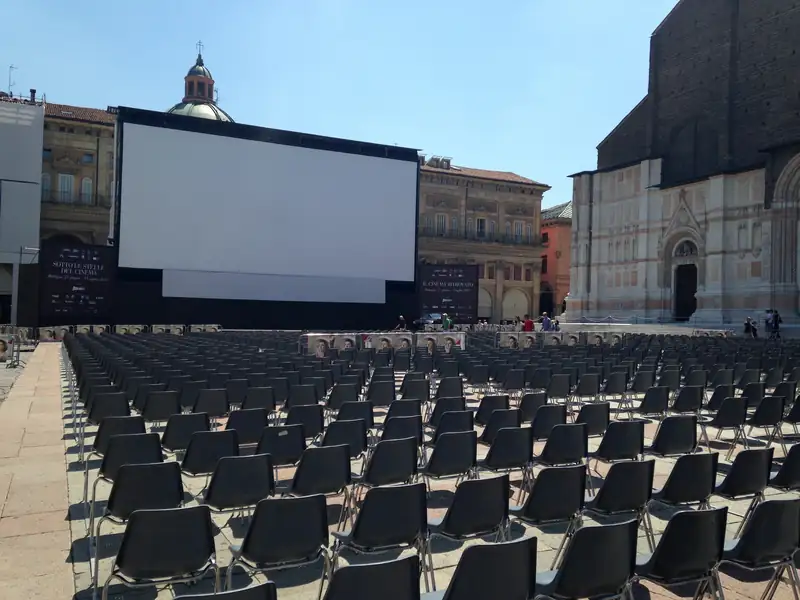
Every summer the Cineteca di Bologna and the city turn Piazza Maggiore into an open-air cinema for Sotto le stelle del cinema. Screenings are free, the program mixes restored classics with contemporary films, and directors and actors regularly turn up to introduce them.
The 2026 edition ran from 15 June to 14 August, roughly 57 evenings, alongside the 40th edition of the Cineteca’s Il Cinema Ritrovato festival. Dates are set annually, so check cinetecadibologna.it for the current year. Turn up early if you want a chair.
Directly behind Palazzo dei Banchi on the east side, four narrow streets carry Bologna’s historic food market: Via Pescherie Vecchie, Via Drapperie, Via Clavature and Via Caprarie. Walk through one of the two larger arches in the palazzo’s facade and you drop straight into it.
This is still the densest concentration of delis, pasta shops and market stalls in the center. Mortadella hanging in windows, tortellini being folded behind glass, wheels of Parmigiano the size of car tires. Go hungry. Our where to eat guide names the specific shops worth stopping at.
On Via Clavature, a couple of minutes inside the Quadrilatero, the church of Santa Maria della Vita holds Niccolò dell’Arca’s Compianto sul Cristo Morto, a late fifteenth-century terracotta Lamentation. Six life-size figures around a dead Christ, caught mid-scream, robes flying backward.
It is the most emotionally violent object in the city and it takes about ninety seconds to understand why people talk about it. As of September 2026 the church opened daily 10:00 to 18:30, last entry 18:00, with a full ticket at €8 and reduced at €5. It is one of the few sights in the center open on Mondays.
The Archiginnasio was built in 1562 to 1563 as the home of the University of Bologna and inaugurated on 21 October 1563. Downstairs is the Biblioteca comunale dell’Archiginnasio, holding around 850,000 volumes including 2,000 incunabula. Upstairs is the reason people come.
The Teatro Anatomico, built in 1636 to 1637, is a wood-paneled dissection hall lined with statues of physicians and watched over by two flayed figures, gli spellati, carved by Ercole Lelli. It was wrecked by bombing in 1944 and rebuilt from the fragments. Booking is generally required and hours run roughly 10:00 to 18:00, closed Sundays. Ticket tiers vary, so confirm on the official site.
Five minutes east along Via Rizzoli, two brick towers lean at each other in the middle of a junction. Asinelli is 97.2 meters tall with 498 steps inside it. Garisenda is 48 meters and leans 3.2 meters out of true, and it has been closed to the public since October 2023 over structural concerns.
Asinelli’s access has been unreliable and we would not build a day around it. Check the official listing before you travel and read our Due Torri page for the current position and the alternatives.
Ten minutes southeast of the square, Piazza Santo Stefano opens out in front of a complex of linked religious buildings that Bolognesi call the Sette Chiese, the Seven Churches.
It is not one church but a stitched-together group built up over centuries: the Church of the Holy Sepulchre, the Church of Saints Vitale and Agricola, the thirteenth-century Courtyard of Pilate, a cloister, a crypt. Tradition holds that Saint Petronius laid it out in the fifth century to echo the holy sites of Jerusalem. Wandering through it feels less like visiting a monument than getting slightly lost indoors.
Bologna’s covered walkways run more than 38 kilometers in the historic center alone and were made a UNESCO World Heritage Site in 2021.
The showpiece is the Portico di San Luca, which climbs southwest out of the city to the Basilica of San Luca on its hill: 666 arches, 3,796 meters, unbroken. Walking it takes an hour or so uphill, and the view from the top is the widest we have found over the city. If you would rather not climb, a tourist train runs out to the basilica and back with time at the top.
Bologna had a canal network once, powering mills and dyeworks and silk production, and most of it was covered over with asphalt in the twentieth century. A few stretches survive in the open, and the best known is visible through a small shuttered window on Via Piella, at numbers 16/a to 18/a.
Look through it and you get the Canale delle Moline running between the backs of the houses, which is why this corner gets called little Venice. It is free, it takes two minutes, and it is easy to walk past because the window is painted the same color as the wall. There are further windows on Via Oberdan and Via Malcontenti.
Bologna’s food is not complicated, but knowing which counter to stand at makes a real difference in the Quadrilatero, where every window looks equally good and some of them are aimed squarely at tourists.
A walking food tour solves that in three hours and gets you to the shops locals actually use. A pasta class solves the other half: you go home able to make tagliatelle and ragù rather than just remembering it. Both run daily from the center, and both are more useful early in a trip than late.
Bologna sits in the middle of Italy’s Motor Valley, and a small-group day tour will get you into the Ferrari and Lamborghini museums with lunch in between. Parma is close enough for a Parmigiano, prosciutto and balsamic day out. Neither needs a car, and both leave from the center.
For everything within the square itself, our sight pages go into more depth on hours, tickets and what is actually worth your time once you are inside.
Last updated 9 September 2026.
3 hours
The city's best-reviewed food walk, led by a Bolognese guide who explains what you are eating and why it matters here.
from$83
Check availability2 hours
An affordable two-hour orientation walk covering the landmarks of the centre, and the most-reviewed tour in Bologna.
from$33
Check availability3 hours
Roll your own fresh pasta, cook a ragù, and finish with wine and gelato in a hands-on class.
from$86
Check availability7 hours
The Ferrari and Lamborghini museums in a small group, with a traditional local lunch on the way.
from$291
Check availabilityPrices and ratings were taken from GetYourGuide and can change. Booking through these links supports this site at no extra cost to you.
Two full days covers this list without rushing. One day is enough for Piazza Maggiore, the Quadrilatero and the towers if you start early and accept that you will miss the museums. Three days gives you room for a day trip out to Motor Valley or Parma.
Yes. The fastest non-stop trains do Florence to Bologna in about 35 minutes, and typical services with a stop or two take closer to 40 to 45. Piazza Maggiore is a 15 to 20 minute walk from Bologna Centrale, so you can be standing in the square within an hour of leaving Florence.
Food, porticoes and the oldest university in the world. The city is the home of tagliatelle al ragù, tortellini in brodo and mortadella, and its covered walkways run more than 38 kilometers in the historic center alone. The University of Bologna has been teaching since the eleventh century.
Very. The historic center is flat, compact and porticoed, which means you can cross it in twenty minutes and stay dry doing it. Everything on this list except San Luca and Motor Valley is within a fifteen-minute walk of Piazza Maggiore.
More than you would expect. Piazza Maggiore, the Neptune Fountain, the whispering gallery under Palazzo del Podesta, the nave of the Basilica di San Petronio, the glass floor at Biblioteca Salaborsa and the partisan memorial wall on Piazza del Nettuno all cost nothing. So does walking the Quadrilatero market streets.
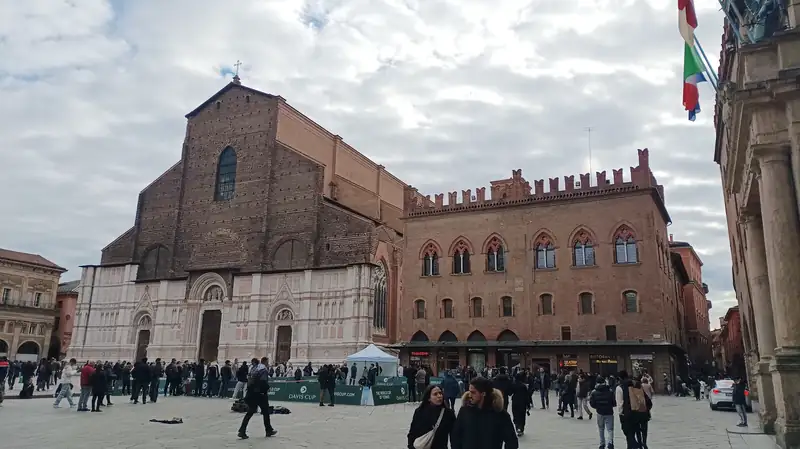
The Basilica di San Petronio fills the south side of Piazza Maggiore.
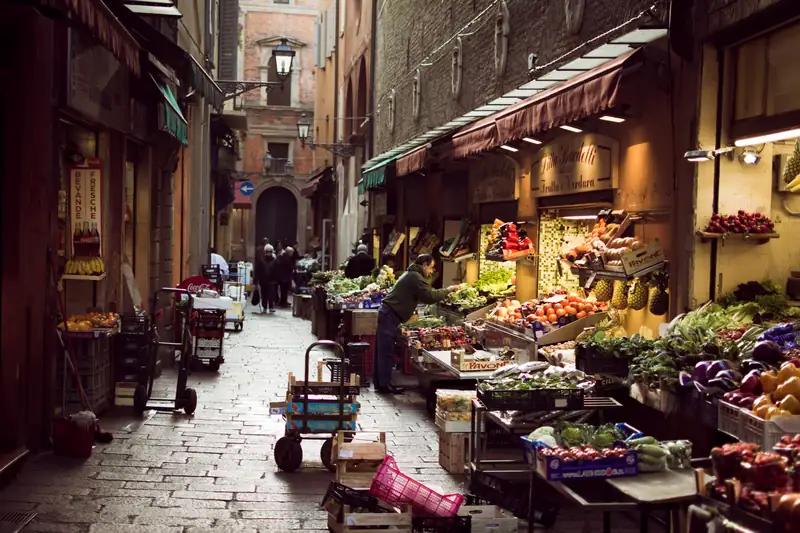
The food is behind the square rather than on it.
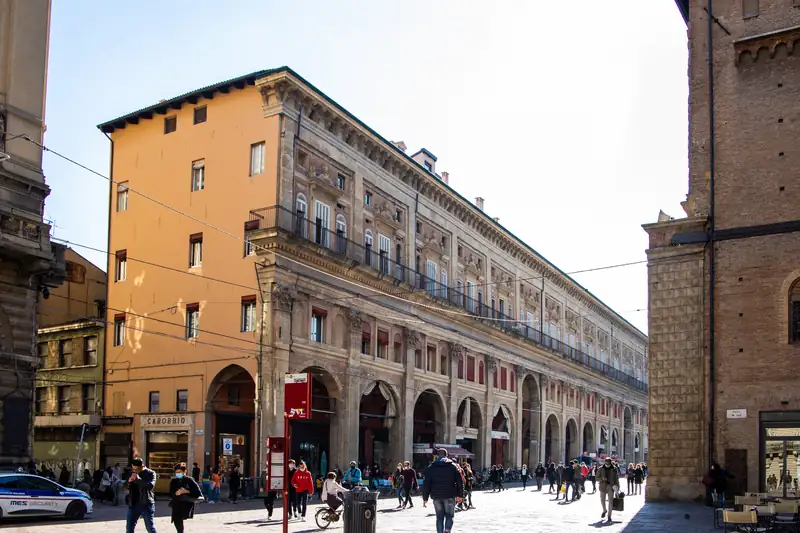
Piazza Maggiore is about 1.2 to 1.5 km from Bologna Centrale station, a flat 15 to 20 minute walk almost entirely under porticoes.
Mid-April to mid-June and September to October are the most comfortable times to be in Bologna.