Walks through Piazza Maggiore
Bologna: City Center Walking Tour
2-3 hours
An affordable two-to-three-hour orientation walk covering the landmarks of the centre, and the most-reviewed tour in Bologna.
from$31
Check availability
Via Tagliapietre 19, 40123 Bologna
Saint Catherine of Bologna (1413-1463) was a Poor Clare abbess whose body sits in a glass case in the chapel of the Santuario del Corpus Domini, Via Tagliapietre 19. The church is 712 metres southwest of Piazza Maggiore, about a ten-minute walk. Entry is free, and the chapel opens on four days a week.
The church people call “la Santa”, after the saint inside, is officially the Santuario del Corpus Domini, at Via Tagliapietre 19, a ten-minute walk southwest of Piazza Maggiore. Entry is free.
Two sets of hours matter. The church itself is open daily, and the Chapel of Saint Catherine, where her body is, opens on only four days. These are the sanctuary’s published times as of October 2026:
| Church | Chapel of Saint Catherine | |
|---|---|---|
| Monday | 09:00-12:30, 15:00-18:00 | Closed |
| Tuesday | 09:00-12:30, 15:00-18:00 | 10:00-12:00, 16:00-18:00 |
| Wednesday | 09:00-12:30, 15:00-18:00 | Closed |
| Thursday | 09:00-12:30, 15:00-18:00 | 10:00-12:00, 16:00-18:00; rosary 18:00-18:30 |
| Friday | 09:00-12:30, 15:00-18:00 | Closed |
| Saturday | 09:00-12:30, 15:00-18:00 | 10:00-12:00, 16:00-18:00 |
| Sunday and holidays | 09:00-11:30, 15:00-18:00 | Sunday 10:00-11:15, 16:00-18:00 |
Mass is at 18:30 Monday to Saturday and 11:30 on Sundays and holidays. From December to April the services move into the sacristy. The sanctuary says hours may change, so check santuariocorpusdomini.it before you go.
Outside chapel hours, visitors have been able to glimpse the saint through a small round window to the left of the high altar. As of October 2026 that window is not accessible because of restoration work, and some paintings by Ludovico Carracci are also temporarily out of view. Plan around the chapel hours.
The Missionari e Missionarie Identes now look after the liturgy and welcome pilgrims. The sanctuary describes itself as a place of peace and adoration and invites visitors to pause in silence. Most people inside are there to pray. Keep your voice low, leave the phone in your pocket in the chapel, and come outside Mass times if you are visiting as a tourist.
Caterina de’ Vigri was born in Bologna on 8 September 1413. Pope Benedict XVI, who devoted a general audience to her in December 2010, described her father, Giovanni de’ Vigri, as rich and cultured. At about ten she was sent to the Este court in Ferrara as a lady-in-waiting to Margherita d’Este, daughter of Niccolò III.
At fourteen she left the court for a community of young women living a religious life, and she later bound herself to the Rule of Saint Clare, joining the Poor Clares, the Franciscan order for women.
In 1456 the city of Bologna asked for a Poor Clare house of its own, and she was sent to lead it as abbess. She arrived on 22 July 1456 and founded the Corpus Domini monastery, the first Poor Clare community in the city. She died there on 9 March 1463.
She left a book, The Seven Spiritual Weapons, written as guidance for her sisters, along with paintings and illuminated manuscripts. Pope Clement XI canonized her on 22 May 1712. Catholics venerate her as the patron saint of artists, and her feast day is 9 March.
According to the sanctuary and to Bologna Welcome, they exhumed her eighteen days later, intending a more dignified burial, and reported that the body showed no sign of decay.
They later placed her seated on a throne. Today she sits upright in a glass case on an antique gilded wooden throne given by the Bentivoglio family in 1488. She wears a Poor Clare habit, which is replaced from time to time.
The chapel also holds objects from her life: a fifteenth-century viella, a stringed instrument, manuscripts, a breviary, paintings and her bed.
It is a striking room, and for many visitors an affecting one. Treat it as what it is: a shrine where people come to pray, not a museum exhibit.
The present church was built between 1477 and 1480. Cardinal Giacomo Monti commissioned a Baroque makeover in 1687, with frescoes by Marcantonio Franceschini. Second World War bombing destroyed the vaults and much of the Baroque decoration, and the building was restored after the war.
Two Bolognese scientists are buried here. Luigi Galvani (1737-1798) lies in a chapel on the left of the nave with his wife, Lucia Galeazzi, and Laura Bassi (1711-1778) is also buried in the church.
The last Poor Clare nuns left the monastery in 2023.
It is 712 metres, about ten minutes on foot. Leave the square at its southwest corner and walk south down Via Massimo D’Azeglio for about 600 metres. Turn right toward Via Tagliapietre, and the church is a short way along.
Combine it with the Basilica di San Petronio, which you pass as you leave the square, or continue across the center to the Santo Stefano complex, another of Bologna’s oldest places of worship. Everything else on this site starts back at Piazza Maggiore.
If you are planning a longer stay, our guide to where to stay in Bologna compares the areas around the center.
2-3 hours
An affordable two-to-three-hour orientation walk covering the landmarks of the centre, and the most-reviewed tour in Bologna.
from$31
Check availability1.5-2 hours
A short small-group walk past the main sights, useful if you only have an afternoon in the city.
from$24
Check availabilityPrices and ratings checked on GetYourGuide in October 2026 and can change. Booking through these links supports this site at no extra cost to you.
Yes, in the Chapel of Saint Catherine inside the Santuario del Corpus Domini. The chapel opens on Tuesday, Thursday and Saturday from 10:00 to 12:00 and 16:00 to 18:00, and on Sunday from 10:00 to 11:15 and 16:00 to 18:00. The small round window beside the high altar is closed for restoration as of October 2026.
Yes. Bologna Welcome lists entry to the Corpus Domini as free, and the chapel has no ticket. The Identes missionaries who care for the sanctuary invite visitors to stop for a moment of silence. It is a place of prayer first, so keep your voice down and avoid visiting during Mass.
For her body, which tradition says showed no sign of decay when it was exhumed eighteen days after her death in 1463, and which now sits upright in a glass case. She was also an abbess, a painter and the author of The Seven Spiritual Weapons, a guide to the spiritual life. She was canonized in 1712.
Catholics venerate her as the patron saint of artists, and she was herself a painter and miniaturist. She is also invoked against temptation. Her feast day is 9 March, and the sanctuary keeps an octave of celebrations each year from 8 to 16 March.
The best known is the state of her body. The nuns reported that it had not decayed when they exhumed it after eighteen days, and the sanctuary describes her being seated upright, at the mother superior's request, as a miracle. Pope Clement XI canonized her on 22 May 1712, nearly 250 years after her death.
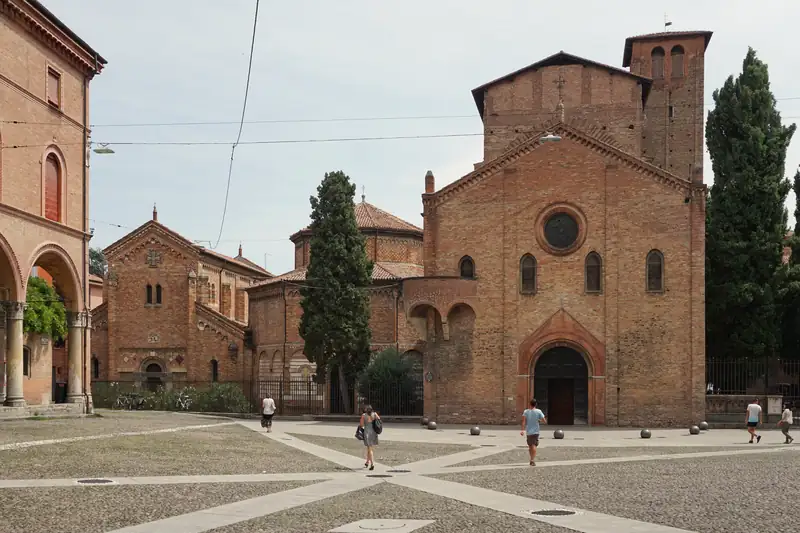
The Basilica di Santo Stefano is a cluster of linked churches, courtyards and a cloister that Bologna calls the Sette Chiese, the Seven Churches.
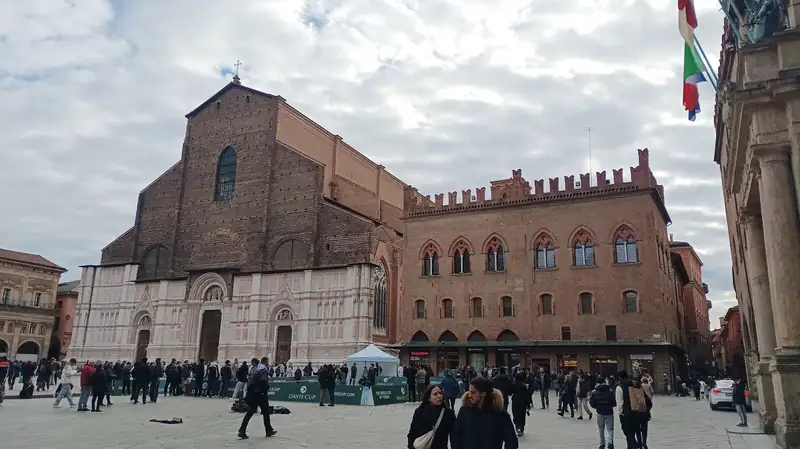
The Basilica di San Petronio fills the south side of Piazza Maggiore.
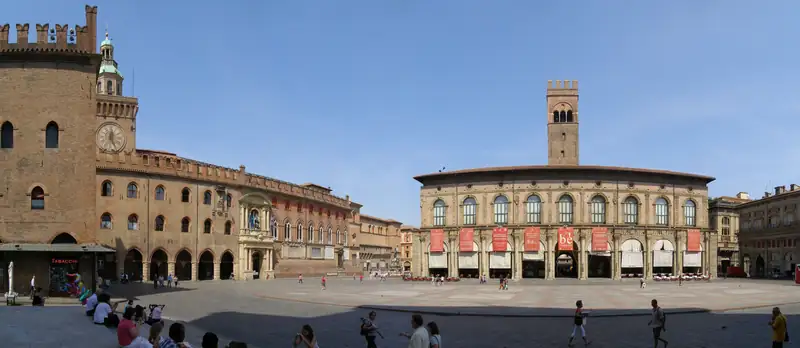
Almost everything worth seeing in Bologna sits within a fifteen-minute walk of Piazza Maggiore.