Walks through Piazza Maggiore
Bologna: Guided Small-Group Tour
1.5-2 hours
A short small-group walk past the main sights, useful if you only have an afternoon in the city.
from$24
Check availability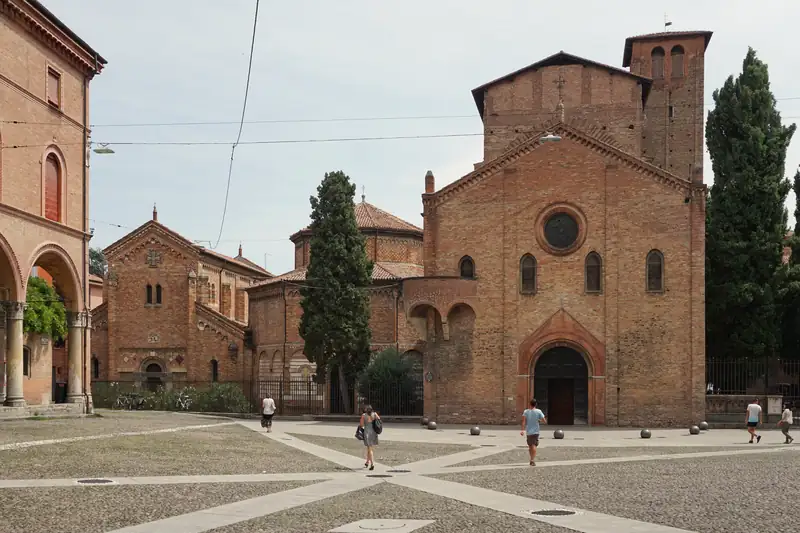
Via Santo Stefano 24, 40125 Bologna
The Basilica di Santo Stefano is a cluster of linked churches, courtyards and a cloister that Bologna calls the Sette Chiese, the Seven Churches. It stands on triangular Piazza Santo Stefano, 575 metres southeast of Piazza Maggiore, about an eight-minute walk. Entry is free, and tourist visits are suspended on Mondays.
Walk into Piazza Santo Stefano and you see what looks like three brick churches side by side. Go through any of the doors and they keep opening into each other: a church, then a round church, then another church, a courtyard, a cloister, a museum. Bologna calls the whole thing the Sette Chiese, the Seven Churches. Its official name is the Basilica Santuario di Santo Stefano.
The basilica’s own website describes it as the cradle and heart of the Bolognese Church. Tradition says that Petronius, bishop of Bologna in the first half of the fifth century, built a copy of the Jerusalem basilica over the places of Christ’s crucifixion and burial here. Most of what you walk through today is medieval, rebuilt and added to by Benedictine monks, and the complex is now looked after by Franciscan friars.
Entry is free. The friars invite donations.
The Chiesa del Crocifisso dates back to the Lombard period in the eighth century. Its presbytery was raised in the seventeenth century, and the crypt underneath, built around 1020 to hold the relics of the martyrs Vitale and Agricola, is seen through glass.
Inside the Basilica del Santo Sepolcro stands a copy of Christ’s tomb, made in the eleventh century from descriptions brought back by crusaders. For centuries this was where the body of Saint Petronius lay. In 2000 it was moved to the Basilica di San Petronio on Piazza Maggiore.
The Basilica dei Santi Vitale e Agricola was rebuilt in the eleventh century for the two martyrs whose bodies were found in 393.
The Cortile di Pilato is a courtyard with a large limestone basin on a Renaissance pedestal. The inscription on its rim dates it to 737-744, under the Lombard kings Liutprand and Ilprand. On a column under the south portico of the courtyard sits a small stone rooster, a reminder of Peter’s denial of Jesus.
Then the Chiesa della Trinità, holding a carved wooden Adoration of the Magi from the thirteenth century, painted in 1370, and the cloister: two levels of arches, the lower probably eleventh century and the upper from the second half of the twelfth. The small museum and the Chiesa della Benda close the circuit.
Official hours, as updated by the basilica on 2 August 2026:
The midday closure from 12:30 catches people out. Mass is said at 18:30 every day, and hours can change for services or special events, so check santostefanobologna.it before a Monday or holiday visit.
These are working churches. Keep voices down and phones silent, and dress as you would for any church in Italy.
The square outside is almost as much of a reason to come. It is a triangle, lined with palazzi.
From Palazzo Isolani on the square, Corte Isolani is a passage of linked courtyards that comes out at Strada Maggiore 19. It is open during the day and makes a good shortcut back toward the Due Torri.
On the second Sunday of each month, and the Saturday before it, the Mercato Antiquario Città di Bologna fills the square and the streets around it with antiques and collectibles stalls. It takes a break in July and August.
It is 575 metres, about eight minutes on foot. Leave the square at its east side by Palazzo dei Banchi, walk straight down Via Clavature through the Quadrilatero market streets, and keep going as it becomes Via Santo Stefano. The road opens into the piazza on your left.
The route is flat and mostly porticoed. Coming back, take Corte Isolani to Strada Maggiore and walk west to the towers, then along Via Rizzoli to Piazza Maggiore. That makes an easy loop.
1.5-2 hours
A short small-group walk past the main sights, useful if you only have an afternoon in the city.
from$24
Check availability2-3 hours
An affordable two-to-three-hour orientation walk covering the landmarks of the centre, and the most-reviewed tour in Bologna.
from$31
Check availability2.5 hours
Starts on Piazza Maggiore, goes inside the Archiginnasio and its wooden anatomy theatre, and finishes with your own climb up the Clock Tower above the square.
from$55
Check availabilityPrices and ratings checked on GetYourGuide in October 2026 and can change. Booking through these links supports this site at no extra cost to you.
For being several churches joined into one. The complex links the Chiesa del Crocifisso, the Santo Sepolcro, the church of Saints Vitale and Agricola, the Cortile di Pilato, the Trinità, a two-storey medieval cloister and a small museum. Tradition says Saint Petronius built a copy of the Jerusalem holy places here in the fifth century.
Yes. The basilica's own website says entry is currently free, and donations are welcome. On some days of the month, volunteers from the Pietre vive group also run free guided visits between 15:30 and 18:00. Large groups are asked to use headphones and to split up above 40 people.
Not for sightseeing. The official hours, updated in August 2026, suspend tourist visits on Mondays, and only the Chiesa del Crocifisso opens, from 18:00 to 19:30, for Mass. From Tuesday to Saturday visits run 09:30 to 12:30 and 14:30 to 19:00, and on Sundays and holidays the afternoon session starts at 15:00.
Sette Chiese is the old Bolognese name for the complex, but no official source explains the count, and today's buildings do not divide neatly into seven. The basilica's own list names the Crocifisso, Santo Sepolcro, Vitale and Agricola, Trinità and the Chiesa della Benda, plus the crypt, courtyard, cloister and museum.
The Portico di San Luca. It runs about 3.8 km from Porta Saragozza up to the Sanctuary of the Madonna di San Luca on its hill, under 666 arches by the usual count. For something shorter, walk from Piazza Maggiore to Santo Stefano along Via Clavature and back via Strada Maggiore.
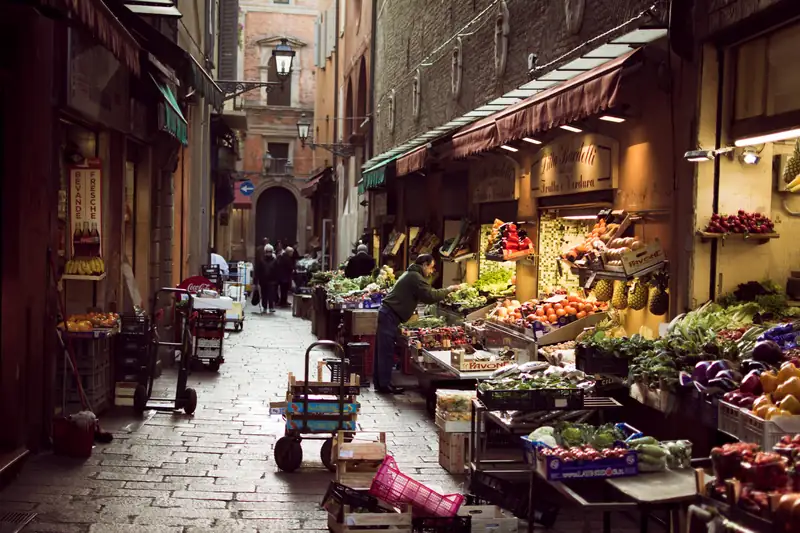
The Quadrilatero is Bologna's old market district, a tight grid of lanes such as Via Pescherie Vecchie and Via Drapperie directly behind Palazzo dei Banchi on Piazza Maggiore.
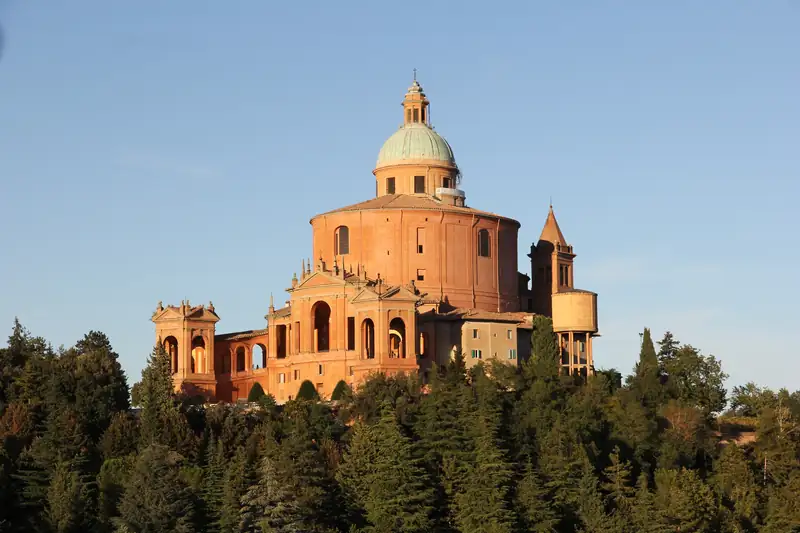
The Sanctuary of the Madonna di San Luca is a hilltop basilica southwest of Bologna, joined to the city by a 3.8 km covered portico.
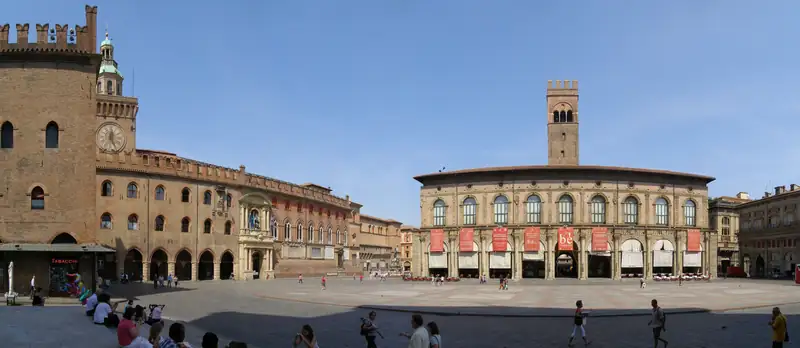
Almost everything worth seeing in Bologna sits within a fifteen-minute walk of Piazza Maggiore.